Early Communication, Toys

Using Puppets to support Speech & Language Development

Imitation Skills

Babies and toddlers generally copy actions before words. Encourage your child to imitate the following actions:

  • Giving the puppet a kiss/ hug
  • Brushing the puppet’s hair
  • Giving the puppet something to eat/drink
  • Getting the puppet to wave hi/bye
  • Giving the puppet a high five!

Symbolic Sounds

Symbolic sounds generally emerge before first words. Model the following sounds for your child and encourage them to imitate you:

  • Mwaaaah for kiss
  • Ooooh for the hug
  • Mmmmm for eating

First words

  • Practise pointing to or naming the different body parts
  • If the puppet has clothes, name the different clothing items
  • Practise saying hi and bye.

Pretend Play

Older children can continue to enjoy using puppets to develop their pretend play skills. Some of the benefits of pretend play include the following:

  • Vocabulary development
  • Concept development
  • Developing your child’s imagination
  • Problem solving skills
  • Turn-taking and sharing
  • Understanding a social situation
  • Developing theory of mind i.e. understanding others’ perspectives
Early Communication, Toys

Building Communication Skills with Bubbles

Bubbles can be used in a fun way to help encourage communication development. Follow the tips below and try them out for yourself.

Use bubbles to teach a word or sign

Blow bubbles for your child and encourage them to ask for ‘more’ or to blow the bubbles ‘again’. This may be through eye contact, gesture/sign, sounds or words.

Use bubbles to help develop phrases

If your child is starting to combine words, practise using phrases such as ‘more bubbles’, ‘more bubbles please’ etc.

Create an opportunity for your child to communicate

Tie the bubbles really tight and give them to your child. This will encourage your child to communicate with you that they need ‘help’. Again, this may be through eye contact, gesture, sounds or words. Model words/signs such as ‘open’, or ‘help’ for your child.

Use bubbles to teach a sound

As you pop the bubbles with your child say ‘pop, pop, pop, pop’ in a quiet voice. Encourage your child to imitate. The [p] sound is one of the first sounds to emerge in speech sound development.

Use bubbles to help develop eye contact

Blowing bubbles can encourage lots of eye contact as your child anticipates more. Wait for your child to make eye contact before blowing again.

Develop cause and effect

Children begin to learn that their actions caused the desired event through cause and effect toys and activities. This paves the way for higher level problem solving and reasoning skills. Children will enjoy using their fingers and hands to pop the bubbles!

Use bubbles to teach simple language concepts

Model the following concepts as you have fun together:

  • Big Bubble
  • Small Bubble
  • Up high
  • Down low
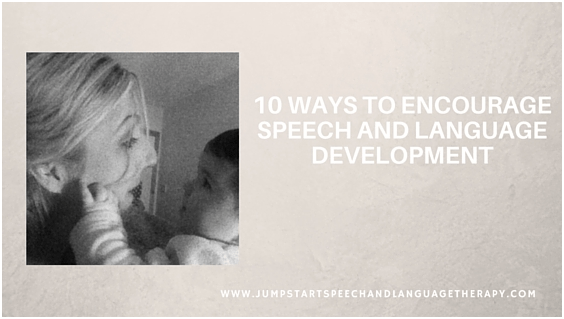
Early Communication

Early Communication Tips

  1. Songs and nursery rhymes are a great way for your child to learn language. Children learn language through repetition and will love singing nursery rhymes over and over again.  Pause every so often and let your child fill in a word!
  2. Come down to your child’s level. Being at your child’s level allows you both to see and hear each other’s message better. Your child will see how your mouth forms the words and any facial expressions you use.
  3. Comment on things in the environment. If your child shows an interest in something, or is doing an activity they really like, give them the language for it. Children need to pair language with the real experience. You can also comment on your own actions e.g. ‘Mummy is washing the dishes’.
  4. Slow down your speech and highlight key words.
  5. Use a variety of words during everyday activities, e.g. common objects, action words, social words, and familiar names.
  6. Your child needs to hear a new word many times before they will understand it. Increase their understanding by showing them the real object or a photograph of the item.
  7. Read books with your child. Books are an excellent way of increasing your child’s vocabulary, developing their turn-taking skills and getting them to listen and attend.
  8. Acknowledge all attempts at communication. This could be any gesture, sound or word your child attempts. When your child feels like they have succeeded, they’ll be encouraged to give you more! 
  9. Try not to test your child by asking too many questions such as ‘What’s this?’ Instead, point things out and label what you both see.
  10. Remember that every activity is a language learning activity and you don’t have to set aside times in the day to learn language. Model words for your child during bath-time or on your trip to the shop!